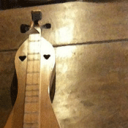
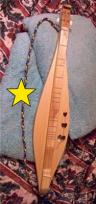
An ebony fretboard is at the top of my list of "must-haves" for every dulcimer I have ever bought, or ever will buy. If you haven't played on one, you're in for a pleasant surprise. You're gonna love it!
Dewey
Since the action of the fingers/ noter/strings will wear away any finish used on a fret board, violin makers adopted ebony for finger board use centuries ago. It's hardness allowed it to resist wear, and the natural oily quality made ebony difficult to varnish. These natural oils made a finish unnecessary on the finger boards. Ebony is still the preferred finger board wood for violin makers. Guitar builders use a lot of rosewood as well, because it's cheaper and in much better supply, but most high end guitars use ebony.
Paul
I would agree that ebony makes iteasier to slide fingersaround and therefore encourages faster fingering. But the hardness of the wood also makes it much more resistant to pick marks. If, like me,you often strum over the fretboard rather than in the strum hollow, and if, like me, you occasionally do so with a little too much exuberance, then you sometimes leave pick marks on the corners of the fretboard. Ebony resists those marks due to the hardness of the wood.
I had a dulcimer with a padauk overlay that was fast, but not as fast as ebony.
I do not believe having a fretboard overlay would affect sound in any way.
I like Ebony or Wenge, I've had great success using Beech as well.
I use just a very light application of lemon oil to clean off the crud and moisturise the wood.
Beware very glassy finishes on fretboards, they are quite contradictory and not as fast as you may think if you have even the slightest trace of moisture on your fingers.
john
First, hardly anyone ever varnishes/lacquers the tiop of the fretboard. Too prone to quickly being worn away and looking nasty. Oiled fretboards are very common. So is an ebony overlay. The advantage of ebony (virtually zero disadvantages) i that that wood is so much harder and finer pored, and thus, when sanded/polished fine, it is much faster when you're sliding fingers or noters up and down. Faster even than a freshly oiled non ebony fretboard polished fine. Few woods are harder - Snakewood and Lignum Vitae come to mind - but they're even more expensive than ebony...
Dulcimer have three courses of strings - bass drone, middle drone and melody. Any of those courses can have two or even three strings. The idea of the doubled melody course is that with the modern more voluminous-bodied dulcimers played traditionally (not-chord melody style), the doubled melody course provided more volume to balance against the increased bass/baritone response inherent in larger bodied dulcimers.
As mentioned above, most builders there days (but not all) use the doubled melody course. From the player standpoint the advantage is that you can play single or double depending on what you prefer.
My recommendation is that you learn to play with the doubled melody course. Then after six months or so of experience you can decide whether you want to continue that way or not.
Check out my blog article called I Just Got A Dulcimer, Now What? It's an illustrated glossary of terms, plus answers to many beginner questions of tuning, playing, care and feeding of your dulcimer:
http://mountaindulcimer.ning.com/profiles/blogs/i-just-got-a-dulcimer-now-what
There are a couple of threads that cover all aspects of this. Here is one . I would stick with a setup that allows either so you have some flexibility, and not let anyone tell you that one way or the other is "wrong." I started with four, and quickly discovered that the doubled melody course didn't suit my playing style. So, I took one off. My second instrument only has three, but I knew I was happy with that setup.
A related question is whether you want an extra fret or two. I had a 1.5 and 8.5 added to my first dulcimer, and bought the second one with them already installed. Unlike tuners, frets are reasonably easy to add later.
Most dulcimers come with a doubled melody string, 2 strings tuned to the same note, and placed very close together. The idea here is to have the melody a bit louder than the other strings. They are and used as if they were one string. Some players like to separate the pair, tuning them to different notes. This allows 4 note chords, and also can allow the use of tunings which have no missing notes. This is used a lot by players who like to play swing and other styles of music that require more complex melodies and chords from outside the key in which the song is written. There are a number of tunings using this setup.
Some players use only a single melody string, either buying a 3 string dulcimer, or removing one of the paired strings. Often this is done to make it a bit easier to learn the instrument, though I don't think the difference is significant, if the string height was properly adjusted before purchase.
Like Rob, I have one dulcimer on which I have tried using several different string set ups. I did go so far as to add a 5th string to it, though, as Rob said, most dulcimers won't have enough space on the peg head to add another tuning machine. I managed to fit one in, but a dulcimer designed for 5 strings might have been a good idea. After all, we all want "just one more."
Some of this is due to players wanting to do things the 3 note tuning doesn't allow. My 5 string lets me do things a bit differently than my other dulcimer. Is it necessary? Not a bit. But we sometimes indulge our whims. Robs suggestions are good. They will allow you to experiment with a few set ups and playing styles without making expensive changes, or buying more dulcimers. Not that buying more is a bad thing, as long as you aren't raiding the kids piggy bank to do so. If there are specific styles of music you want to play, this may affect your decision. What do you have in mind?
Paul
Angela. get one with four, but with the nut and bridge notched for different configurations: paired melody, paired middle, 4 independent or like Robin says take one off and use 3. I like 4 stringers so I can change 'em around. I keep several in 4 independent, a couple I've taken one off and play with 3, and 2 I keep with paired melody for (primarily) noter playing. Your big names like McSpadden & Folkcraft come that way from the shop. Many individual makers do the same, or will notch the bridge and nut as you want. Again, with 4 you can take one off, but you can't add one to a 3 string (my opinion.)
Rob
Hi, Angela! I have dulcimers with 4 tuning pegs yet I only have 3 strings on them. The number of strings is really just a matter of personal preference (based on different factors, the type/style of music you wish to play being one of those factors).
There is a "For Sale" area that can be found by by clicking on FORUMS/discussions in the green strip above and scrolling down the page a bit. Oftentimes these are used instruments for sale. Here is a link you may wish to spend some time checking out:
http://mountaindulcimer.ning.com/group/beginnerplayers/forum/topics/what-should-a-beginner-look?commentId=3745489%3AComment%3A83151&groupId=3745489%3AGroup%3A36
Hope this helps!
Piet;
Yep, similar, but depending on how each is aged 'cured' it will work a little differently. I've had some white tail antler that is harder than bone but works very well with a good file then finish sanding. Cow, sheep and buffalo horn will have layers so you have to account for that. Hoof from a cow, deer or buffalo is usuall thin and makes pretty good inlay material. It takes glue pretty good. You'll find variation even in bone, it's just more pronounced in some other 'critter parts'. If you work with cow horn, make sure it's cured ... good bit of shrinkage as it dries out.
Sam
Pieter Sanders said:
Hey, Sam.....what are antler, horn and hoof like to work with? Similar to bone, I would guess? Piet.
Sam said:Love working bone ... hate the smell. I've used bone, antler, horn and even hoof to make doo dads and embellishments for a lot of the projects I enjoy. This is a great story, much enjoyed.
This reminds me of a very sad story from Mongolia called Suho and the White Horse.It's definitely not my favorite as a boy' loses his beloved horse. The horse's bones are used to make the horseheaded fiddle that is a Mongolian folk instrument.
Fortunately your story has a happy ending for your local fox.
Contact Dave Lynch, at Sweetwoods and have him make one of his travel dulcimers with a second top. http://www.strothers.com/sweetwoodsinstruments.com/dulcimers.php Go here, and click on Specialties.
Paul
The concept of incorporating it into a "courting" dulcimer-like instrument might be the one that makes the most sense if you want to have the ability to play both a diatonic, and a chromatic dulcimer in one instrument. The fret boards could either run parallel or opposite each other depending on whether it would make more sense to play each one by turning the instrument around or more like a 12-string guitar idea.
And yeah, we're probably all nuts! 
How about doing a courting dulcimer with both fretboards put on in the same direction? I know that my brother, Dave Lynch of Sweet Woods Instruments made a courting box type of dulcimer with double fretboards for a customer who wanted to play different tunings without switching instruments. One of those fretboards could just as easily been a chromatic one.
Easier by far to build a double dulcimer with one diatonic and one chromatic fretboard the engineering to make a replaceable fretboard only would be very complex. Harpmaker's Travel dulcimer with the slide off/on top comes closest conceptually.
The VSL for any two types of fretboard can be any length you like as long as you can calculate the fret spacing.
Check out http://www.bearmeadow.com/tools/flexifrets-install/index.html
Not a replaceable fretboard, just frets.
I would think the idea is worth trying out but I would install it with some kind of stops or keys to prevent sliding around from handling\, ie.,removable pins at each end.
The fret board could be chromatic on one side and diatonic on the other, just turn it over to switch. Screws for holding it in place.
But I would just as soon have a plain permanent chromatic since it's just a diatonic with additional frets. :>)
Hey Whit, I normally play it in Em. I tuned my baratone to FCF and capoed on 1 and played it. I have Martin Jazz strings on my baratone and it did just fine. You can play any DAD tab capoed on1with it tuned this way if your dulcimer will tune down that low. Its really Low. Could do the same thing ona bass as well. Probably too floppy on a standard dulcimer unless you use heavy strings. I use a 10/14/23 on my standard. I play in Bflat a lot there tuning to Bflat, F, Bflat and its pretty loose.
Edward - I have used the Herdim picks forever - but after reading your post here, I am going to try the V-pick.
Anxious to get them (I am ordering a traditional, large and freakishly large - ultra light). I will post when I get them!
Thanks for the tip!
Edward I Ball said:
Hello Leighann, I tried different picks from Eldely, then saw from videos that Bing Futch endorsed V-Picks so I ordered couple each of there "Bing" dulcimer picks, I love the ultra lite, not to bendy, but they are an acrylic that is not sticky, but warms and grips to your hand, also have a great sound, I ordered couple more of each for a friend, who also loves them, little expensive, but last a long time. You can just look up V-Picks online, fast service.
The "problem" with nail strumming is that you don't get enough volume to be heard more that 6 feet away in a quiet room. Yes, I spent something like years just strumming out, using a Herco brand plastic Thumb-Flat pick. Basically a flat pick with a thumb-sized loop. With practice you can get rally fast with that thumb pick. If you play with things you may be able to strum out with the thumb pick and strum in with a finger pick on another finger.
If you learn to finger-pick you can wear the whole complement of finger picks.
Dropping flat picks usually happens because you're not holding on to enough of the pick (i've seen some beginners using only two fingertips); and are trying to keep the pick rigidly at right angles to the strings. A better technique is to only expose about 1/4" or so of the pick tip, and bury the rest of the pick in your fist. Then strum by rotating the the whole wrist so that the pick brushes the strings, not clicking past each one.
If you have trouble dropping picks, try smearing the wide part of the pick with some rubber cement or something to rough it up.
Hi Leighann,
When you first start to knit you usefat needles, go slow and drop stiches but as your skill and accuracy increase you can knit faster with precision using thinner needles and drop less stiches. Eventually, the skill of knitting is 'automated' and your brain can even do other things like chatting whilst happily knitting away 
Strumming a dulcimer is exactly the same. Strumming with a pick is a physical skill that requires a very high degree of precision, speed andaccuracy and hours and hours of practice. You can use 'big picks' or other techniques like sticky picks to help the learning process along the way. But, over time, you'll simply and imperceptibly just get better at strumming and holding on to your pick (whatever type of pick you choose to use in the long run). It is one of those skills that just evolves without too much analysis alongside learning tunes.
...but being my nerdy self, I'm researching a lot and playing less...
And therein lies the rub! We nerds sometimes need to learn to let go of the head stuff and simply rely on physical experience, without analysis, to get us to the next stage. And it can be fun to move away fromour preferred theoretical learning style and be a free child activist for a while and just see what happens experientially
Robin